
Losing a tooth is common, whether through decay, gum disease, an accident or a tooth that couldn’t be saved. There’s more than one way to fill the gap, and the right one depends on how many teeth are missing, the health of the teeth and gums around them, how much bone you have, your budget and how you feel about something removable.
Here’s a plain guide to each option, who it suits and what to expect, from the team at Confidence Dental in St Helier.
Why replace a missing tooth?
- The teeth either side can drift or tip into the gap, and the tooth above or below can move into the space, which can change your bite.
- The bone where the tooth was gradually shrinks. When several teeth are missing, this can change the shape of your face, and it can make implants harder later.
- Chewing on one side puts extra load on the teeth you have left.
- A gap at the front can affect your confidence when you smile or speak.
That said, a single gap at the back that isn’t causing problems doesn’t always need filling. Leaving it can be a reasonable choice, and we’ll tell you honestly if we think it is.
Your options at a glance
| Option | Fixed or removable | Time to complete | How long it lasts | Upfront cost | Often best for |
|---|---|---|---|---|---|
| Dental implant | Fixed | Usually 3 to 6 months, including healing | 20 years or more with good care | Highest per tooth | One or two missing teeth, with healthy gums and enough bone |
| Implant bridge | Fixed | Usually 3 to 6 months | 20 years or more with good care | High | Several missing teeth in a row |
| Full-arch implants | Fixed | Temporary teeth where needed; final teeth after 3 to 6 months | Long term, with good care | Highest overall | All the teeth in a jaw missing or failing |
| Fixed bridge | Fixed | Two or three visits over a few weeks | Often 10 to 15 years | Medium | A gap next to teeth that already have large fillings or crowns |
| Adhesive bridge | Fixed | Usually two visits | Many years; it can come loose and be re-bonded | Lower | A single front tooth, with healthy teeth either side |
| Partial denture | Removable | A few visits over several weeks | Usually remade every 5 to 10 years | Lowest | Several gaps, or when implants aren’t suitable |
| Implant-retained denture | Removable, clips on | Usually 3 to 6 months | Long term, with good care | Medium to high | A loose denture, especially a lower one |
| Complete denture | Removable | A few visits over several weeks | Usually remade every 5 to 10 years | Low | All the teeth in a jaw missing |
Fixed options
The two most common fixed options are an implant and a bridge. The difference is what holds the new tooth in place.
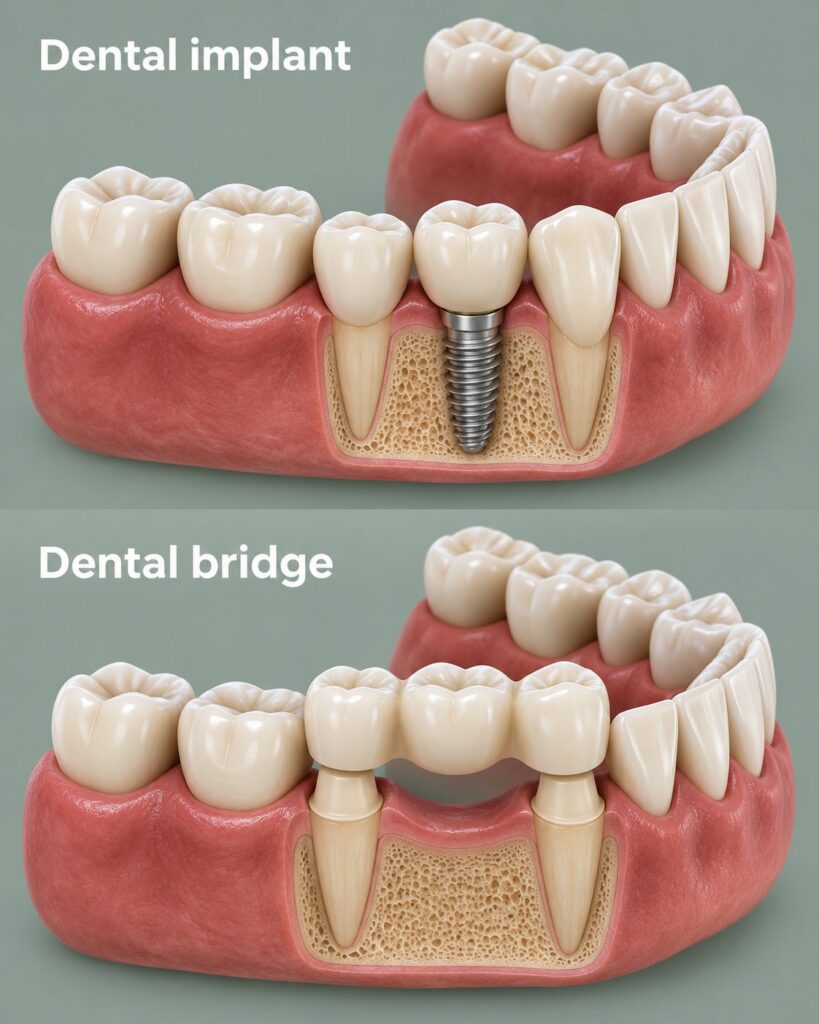
Dental implant
A titanium or ceramic post is placed in the jawbone where the root used to be. Once it has bonded with the bone, usually over three to six months, a crown is fitted on top. It looks, feels and works like a natural tooth.
Right for you if: you’re missing one or two teeth, your gums are healthy and you have enough bone, or are happy to have bone added first.
- Pros: doesn’t touch the teeth either side; helps protect the jawbone; can last 20 years or more with good care.
- Cons: the highest cost per tooth; a minor surgical procedure; takes a few months from start to finish.
Implant bridge
Two implants hold a bridge of three or four teeth, so you don’t need an implant for every missing tooth.
Right for you if: several teeth are missing next to each other.
- Pros: fixed and stable; fewer implants than teeth.
- Cons: as for implants, it needs healthy gums and enough bone.
Full-arch implants
A fixed bridge of a full set of teeth on implants, usually six per jaw. Temporary teeth can be fitted while the implants heal.
Right for you if: all the teeth in a jaw are missing or failing, or you want to replace a denture with teeth that stay in.
- Pros: no plate and no adhesive; teeth that don’t come out; you can bite and chew with confidence.
- Cons: the biggest investment, and it needs planning with a 3D scan.
More about full-arch implants.
Fixed bridge
A false tooth is joined to crowns on the teeth either side of the gap, which are shaped to hold it.
Right for you if: the teeth either side of the gap already have large fillings or crowns, so shaping them does little extra harm.
- Pros: fixed, quicker than an implant and no surgery.
- Cons: the teeth either side have to be shaped; if one of them has a problem later, the whole bridge can be affected.
Adhesive bridge
A false tooth with a small wing that is bonded to the back of the tooth next to it, with little or no drilling.
Right for you if: a single front tooth is missing and the teeth either side are healthy.
- Pros: minimal drilling, quick and lower cost.
- Cons: less strong than a conventional bridge, and it can come loose, though it can usually be re-bonded.
Removable options
Partial denture
Replacement teeth on a plate that clips onto your own teeth. Acrylic dentures are made entirely of tooth- and gum-coloured acrylic; chrome cobalt dentures have a thin metal frame, so they’re slimmer and less bulky.
Right for you if: several teeth are missing in different places, you want the lowest-cost option, or implants aren’t suitable for you.
- Pros: the lowest cost; no surgery; easy to add teeth to later.
- Cons: it comes out to clean; it can feel bulky at first; it rests on the gums and teeth, and needs remaking as your mouth changes.
Implant-retained denture
A denture that clips onto a small number of implants, so it stays put when you eat and speak but still comes out to clean.
Right for you if: your denture, especially a lower one, moves or rubs, and you’d like it to stay in place without the cost of a full fixed bridge.
- Pros: far more secure than a normal denture; fewer implants than a fixed bridge.
- Cons: it still comes out to clean, and the clips need replacing from time to time.
Complete denture
A full set of teeth on a plate for an upper or lower jaw.
Right for you if: all the teeth in a jaw are missing and you want a straightforward, lower-cost option.
- Pros: the lowest-cost way to replace a full set of teeth.
- Cons: lower dentures can be loose; you may need adhesive; it needs remaking as your gums change.
Leaving the gap
For a single back tooth that isn’t affecting your bite, doing nothing can be a sensible choice. We’ll keep an eye on the teeth around the gap at your check-ups.
Which option is right for you?
A few common situations, and what we’d usually suggest discussing:
- One missing front tooth, healthy teeth either side: an implant, or an adhesive bridge if you’d rather avoid surgery.
- One missing back tooth next to heavily filled teeth: a fixed bridge or an implant.
- Several gaps on a budget: a partial denture, with the option to move to implants later.
- A loose lower denture: an implant-retained denture.
- All teeth missing or failing in a jaw: full-arch implants, or an implant-retained denture.
Your general health matters too. Smoking, poorly controlled diabetes and some medicines can affect healing after implant treatment, so we’ll go through your medical history with you.
How we help at Confidence
Replacing teeth is the special interest of Dr Sharad Patel, who has a master’s degree in prosthodontics, over 30 years in dentistry and a Fellowship of the International Congress of Oral Implantologists. At your consultation we examine your mouth and, if implants are an option, take a 3D CBCT scan here at the practice to check your bone. You’ll leave with a written plan and estimate for each option that suits you, so you can compare them properly.
To spread the cost, you can use your dental insurance, Pension Plus if you’re eligible, or a payment plan on larger treatment. Our fees are in our price guide.
To talk through your options, call us on 01534 875 587 or book online.
Frequently asked questions
What is the best way to replace a missing tooth?
For a single missing tooth with healthy gums and enough bone, a dental implant is usually the longest-lasting option because it doesn’t rely on the teeth either side. But a bridge or a denture can be the better choice depending on your neighbouring teeth, your health and your budget. We’ll go through what suits you.
Do I have to replace a missing back tooth?
Not always. If the gap isn’t affecting your bite or the teeth around it, leaving it can be reasonable. We’ll check whether the teeth either side or opposite are starting to move.
Am I too old for dental implants?
There’s no upper age limit. What matters is your general health, your gums and how much bone you have, which we check with a 3D scan.
Can I have implants if I smoke or have diabetes?
Often, yes, but smoking and poorly controlled diabetes make implants more likely to fail, so we’ll talk this through and may suggest steps first.
Can I change from a denture to implants later?
Yes. Many people start with a denture and move to implants later. See changing from dentures to fixed teeth.
How much does it cost?
It depends on the option and how many teeth are involved. You’ll get a written plan and estimate before any treatment, and our fees are in our price guide.


